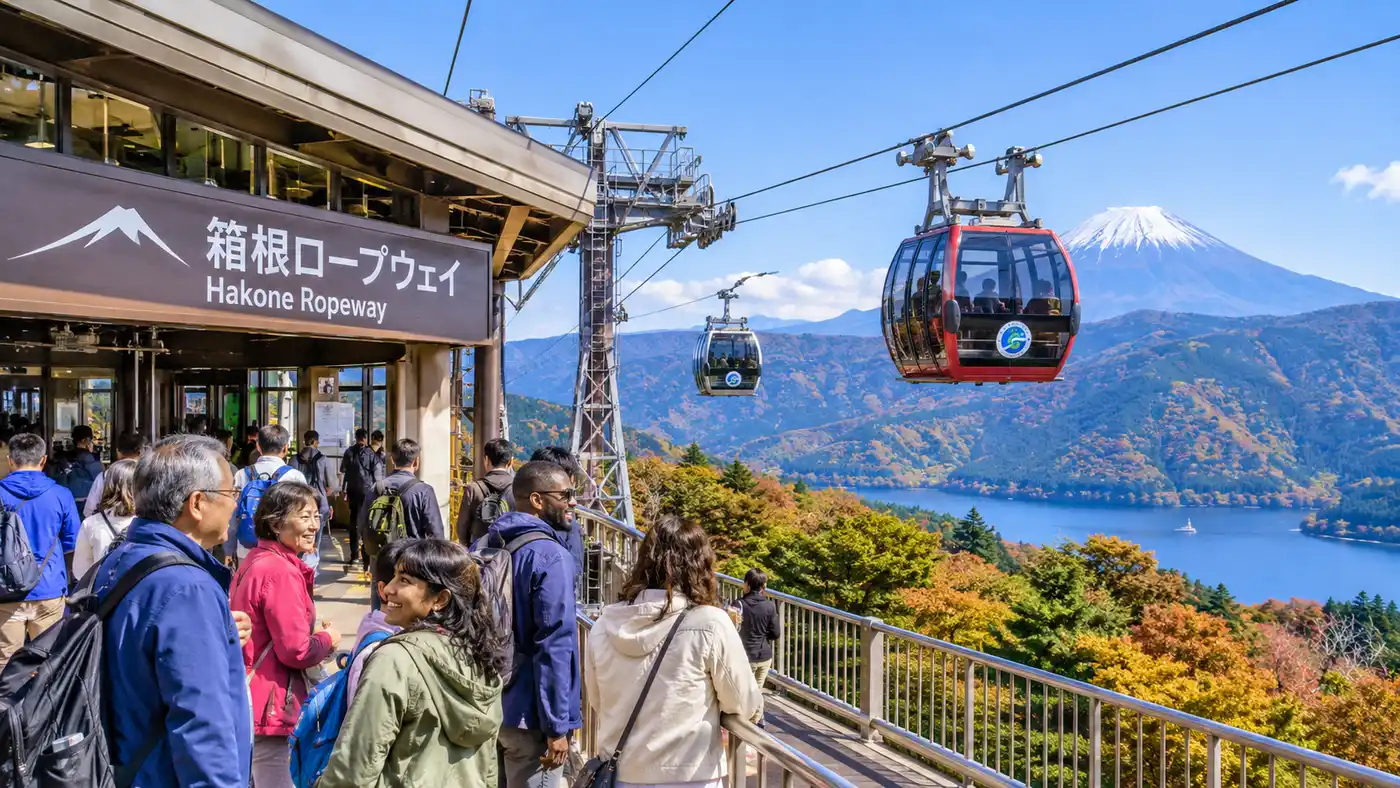
Hakone Ropeway Ticket Prices, Costs and Booking Guide
Standing on the concrete platform at Sounzan with sulfuric mist creeping over the mountain ridge, you will probably see dozens of people clutching small paper slips. Sorting out your hakone ropeway ticket before you reach that turnstile saves twenty minutes of shuffling behind tour groups. The lift carries you straight over an active volcanic crater, and on a crisp day you can see Mount Fuji standing sharp against the sky.
Most travelers arrive thinking transit in the mountains operates just like the Tokyo subway. It does not. The ropeway is an aerial tramway system divided into distinct legs, operated by the Odakyu Group, and priced with a mix of one-way tariffs, round trips, and network transit passes. Below is everything you need to know about the actual money involved, where travelers overpay, and how to ride without getting stuck at an automated ticket machine that refuses to accept your foreign bank card.
Book your hakone ropeway experience:
Point-to-Point Fares: How Much Is Hakone Ropeway Travel?
If you choose to pay out of pocket instead of using a regional transit pass, the hakone ropeway ticket price depends on how far down the mountain you go. The entire route spans four stops: Sounzan, Owakudani, Ubako, and Togendai on the shore of Lake Ashi. Owakudani sits right in the middle at the highest elevation, serving as the required transfer hub where everyone switches cabins.
Riding the full distance one-way between Sounzan and Togendai costs 1,550 yen for adults and 780 yen for children aged six to eleven. If you decide to do a full out-and-back trip, an adult round-trip ticket will run you 2,800 yen. Kids pay 1,400 yen for the same journey. Toddlers and infants under six ride free of charge with a paying adult, up to two small kids per grown-up.
Short hops between adjacent stops cost less, but they add up fast if you buy them sequentially. Owakudani to Togendai costs 1,200 yen one-way, while Sounzan up to Owakudani costs 1,050 yen. Buying those two sections separately as single fares costs 700 yen more than buying the continuous full-route ticket, so know where you want to finish your trip before standing at the vending window.
| Segment | Adult One-Way | Adult Round-Trip | Child One-Way | Child Round-Trip |
|---|---|---|---|---|
| Sounzan to Togendai (Full Line) | ¥1,550 | ¥2,800 | ¥780 | ¥1,400 |
| Sounzan to Owakudani | ¥1,050 | ¥1,850 | ¥530 | ¥930 |
| Owakudani to Togendai | ¥1,200 | ¥2,150 | ¥600 | ¥1,080 |
| Ubako to Togendai | ¥900 | ¥1,600 | ¥450 | ¥800 |
Note: Physical ticket machines at Sounzan and Togendai accept Japanese yen cash and major IC transit cards like Suica or Pasmo, but machines frequently reject non-Japanese credit cards. Keep paper currency in your wallet.
Individual Ticket vs. Hakone Ropeway Pass Options
Almost nobody should buy a single point-to-point ticket. A standard round trip on the ropeway costs 2,800 yen, which represents nearly half the total price of a two-day regional transit pass. If you plan to ride the mountain railway from Hakone-Yumoto, switch to the cable car at Gora, float across Lake Ashi on the pirate boat, and take a bus back down to the valley, paying separate fares is a financial mistake.
Picking up a Hakone Free Pass gives you unlimited boarding on all eight local transit lines, including every section of the ropeway. A two-day pass starting from Odawara costs around 5,000 yen for adults. That single investment covers your cable cars, mountain trains, local buses, and lake ferries alongside the ropeway itself. You simply flash your paper ticket or phone screen at the ropeway attendant and walk straight through the turnstile queue.
Here are the payment methods and ticketing routes you can choose from:
- Odakyu Hakone Free Pass: covers the entire ropeway line with unlimited boarding for two or three consecutive calendar days.
- Paper single tickets: sold at physical station windows and automated touch-screen kiosks at Sounzan, Owakudani, and Togendai.
- Digital EMot pass: a smartphone-based version of the transport pass that displays an animated QR code to station staff.
- Prepaid IC cards: Suica, Pasmo, and Icoca cards work at the ticket windows to purchase ropeway tickets, though you cannot simply tap your card directly at the gate.
I learned this the hard way on my first visit. I bought individual paper tickets between each stop because I was unsure if I wanted to ride the boat across Lake Ashi later in the afternoon. By 3 PM, I had spent 4,600 yen on disjointed bus, train, and ropeway fares. Buying the pass at Odawara in the morning would have saved me money and eliminated three separate queues at crowded ticket counters.
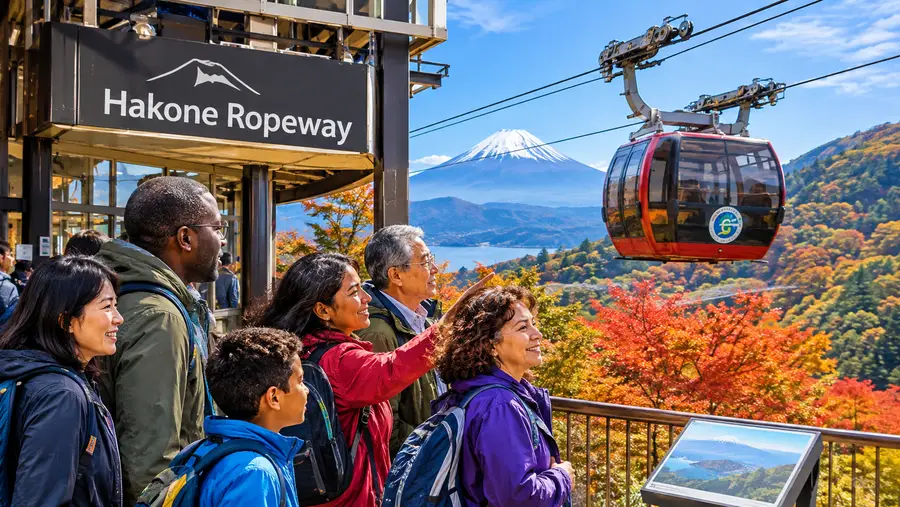
Can You Book Hakone Ropeway Tickets Online or Make a Reservation?
Many travelers search frantically for a hakone ropeway reservation window before flying to Japan. You cannot reserve a specific departure time or gondola seat on the Hakone Ropeway. The system runs on a continuous loop, exactly like a high-capacity ski lift, with 18-passenger cabins pulling into the loading dock every sixty seconds.
You can, though, buy hakone ropeway tickets online in the form of a digital pass via Odakyu's EMot browser service or through third-party platforms like Klook. When you purchase an electronic voucher through a third party, you typically receive a QR code. Depending on the specific vendor, you either show that mobile voucher directly to the station attendant or trade it for a physical ticket at Odawara Station before boarding your first train into the mountains.
Pro tip: If you buy a digital pass on your phone, take a screenshot of your order confirmation number before leaving your hotel. Cell reception drops sharply when clouds roll through the volcanic valley between Sounzan and Owakudani.
Wait times fluctuate wildly based on tour bus schedules. Between 11 AM and 1:30 PM on weekends, the boarding line at Sounzan often stretches across the upper mezzanine. Even with a crowd of three hundred people in front of you, the line moves rapidly because gondolas arrive and swallow eighteen passengers every minute. Total wait time rarely exceeds twenty-five minutes unless high winds force the operators to slow the cable speed.
Book your hakone ropeway experience:
What Does the Hakone Ropeway Entrance Fee Cover?
Calling the fare a hakone ropeway entrance fee is slightly misleading. The ropeway is classified as public transportation under Japanese transit law, so your ticket covers your passage across the valley rather than entry to an enclosed attraction park. Once your gondola touches down at the ridge, access to the walking paths around Owakudani's volcanic valley is entirely free.
Stepping out of Owakudani Station drops you onto an exposed mountain plateau smelling heavily of sulfur. The walking trails leading toward the steaming vents, the observation decks facing Mount Fuji, and the volcanic museum gift shop do not require extra admission tickets. The only thing you will pay for up there is your food, including the famous black eggs boiled directly in the mineral-heavy thermal pools, which currently sell for 500 yen for a bag of four.
The ticket does not cover luggage storage. If you carry large rolling suitcases onto the ropeway, you can bring them into the gondola cabin for free, but doing so crowds your fellow passengers. Owakudani Station has coin-operated lockers near the restrooms that cost between 400 and 700 yen depending on locker size. Most larger lockers fill up by noon, so ship heavy bags ahead via your hotel or drop them at Hakone-Yumoto Station before heading up the mountain.
Real Traveler Review: Is the Hakone Ropeway Worth It?
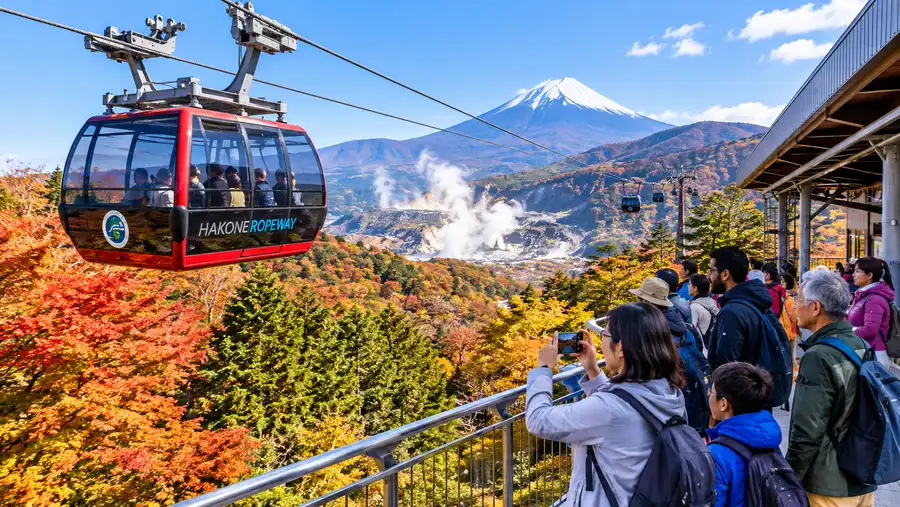
The entire ride from Sounzan to Togendai takes roughly 30 minutes of total travel time, divided into two distinct fifteen-minute segments. As your gondola clears the ridge past Sounzan, the ground beneath you drops away suddenly into a yawning, yellow-streaked ravine venting white steam. It smells pungent, like lighting a dozen match heads at once. On a clear day, Mount Fuji emerges immediately to your right, framed by the cabin glass.
Is the hakone ropeway worth it? Absolutely, if the weather cooperates. Floating high above the smoking fissures gives you a vantage point you cannot reach from any mountain road or hiking trail. But if dense fog rolls in, which happens often in autumn and spring, the experience changes completely. You will pay full price to sit inside a metal box wrapped in white mist for half an hour, seeing nothing beyond the condensation on your window.
Consider these points when deciding whether to add the ropeway cost to your Hakone budget:
- Clear sky mornings: unmissable views of Mount Fuji and the raw, smoking sulfur vents below Owakudani.
- Bad weather alternatives: heavy fog or rain reduces visibility to zero, turning the ride into transport rather than sightseeing.
- Respiratory sensitivity: the volcanic sulfur gases can cause throat irritation and coughing, making the outdoor platforms tough for travelers with asthma.
- Logistical flow: riding the ropeway is the natural, seamless route connecting Gora to the Lake Ashi sightseeing boats.
I think the ropeway remains the centerpiece of the entire regional loop. Even when sulfur gas prompts station staff to hand out moist paper towels at the boarding gate, the visual drama makes it worthwhile. Skip it only if the summit is buried in thick mountain storms or if the cable line has been shut down by gale-force winds.
Frequently Asked Questions about hakone ropeway ticket
Can I buy a hakone ropeway ticket with a credit card at the station?
Ticket windows staffed by attendants generally accept Visa and Mastercard, but self-service automated kiosks at the stations often require Japanese yen cash or local transit IC cards like Suica. Always carry enough paper cash to cover your party's fares in case the card machines are offline.
What happens to my ticket if the ropeway closes due to strong winds?
If volcanic activity or severe winds shut down ropeway operations, Odakyu operates substitute buses along the highway between Sounzan, Owakudani, and Togendai at no extra charge. If you purchased an unused point-to-point ticket for a closed segment, you can claim a cash refund at the station ticket counter.
Do children get a discount on the hakone ropeway fee?
Yes. Children between the ages of six and eleven pay roughly half the standard adult fare on all legs. Children under the age of six ride for free, provided each child is accompanied by an adult traveler.
Quick Reference
- Adult full one-way fare: 1,550 yen
- Adult full round-trip fare: 2,800 yen
- Included in Hakone Free Pass: yes (unlimited rides)
- Seat reservations: not available (continuous boarding)
- Cashless payment: staffed counters only; kiosks require cash or IC cards
Book your hakone ropeway experience:
Is It Worth It?
If you are traveling through the mountains, the ropeway will likely become the memory you talk about most when you get home. Do not buy single tickets at each station turnstile. Grab a transit pass before you leave Odawara, keep some emergency yen in your coat pocket for hot snacks at Owakudani, and check the morning mountain weather webcam before you step onto the platform.
Read more about hakone ropeway.